
SEO Beyond Rankings: What Brands Should Actually Focus On.
SEO is about more than reaching the first page of Google. Sustainable organic visibility comes from understanding search intent, website structure, content, technical performance and the signals that actually matter.
Relevance, structure, content and performance working together.
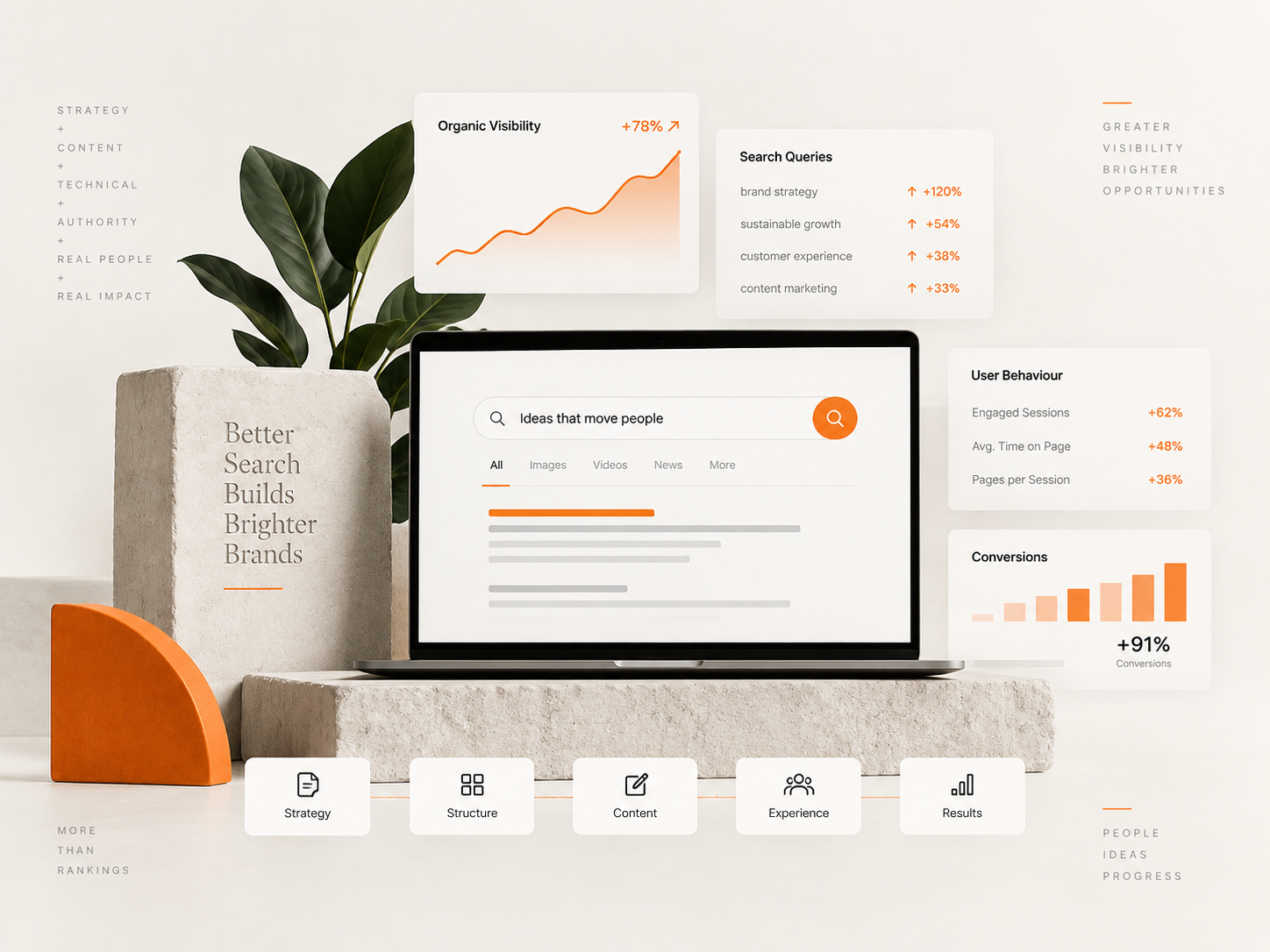
For years, SEO has often been reduced to one question: “How high do we rank on Google?”
Ranking matters, but it is only one part of a much bigger picture. A website can rank for multiple keywords and still attract the wrong audience. It can generate organic traffic without meaningful engagement. It can even appear prominently in search results while failing to guide users towards the next step.
For brands, effective SEO is not simply about visibility. It is about becoming visible for the right searches, to the right audience, with the right content and website experience behind them.
Start with search intent, not keywords.
Keyword research remains an important part of SEO, but looking only at search volume can lead to the wrong decisions.
The more useful question is: what is the person behind the search actually trying to do?
Someone searching for a broad informational topic is in a very different stage of their journey from someone comparing providers or looking for a specific service.
Learn, understand or explore a topic.
Compare options and evaluate solutions.
Take an action, purchase, book or contact.
Find a particular brand, website or destination.
A strong SEO strategy connects queries with real user needs, rather than simply placing popular keywords throughout a website.
Website structure matters more than it looks.
A well-designed website is not only easier for users to navigate. Its structure also helps search engines understand what the business offers and how different topics relate to one another.
When every important service has a focused page, supported by relevant internal links and related content, the website communicates a much clearer hierarchy.
Good website architecture therefore supports both SEO and the overall user experience. Search engines receive clearer context, while visitors can move through the website more naturally.
Technical SEO creates the foundation.
Great content can only perform properly if search engines can access and understand the website.
Technical SEO looks at the underlying factors that may affect organic visibility.
Technical SEO is rarely the most visible part of a strategy, but it creates the foundation for everything that follows.
Content should answer real questions.
Publishing content simply because “SEO needs articles” usually leads to pages that provide little value.
Useful SEO content begins with actual demand: what the audience is searching for, what questions appear before someone chooses a product or service, and which subjects need more explanation than a service page can reasonably provide.
“The objective is not to create more content. It is to create more relevant content.
SEO and brand should work together.
SEO sometimes becomes overly mechanical. Keywords are inserted into titles. Pages are created purely around search phrases. Copy becomes repetitive because the algorithm becomes more important than the person reading it.
That approach can weaken the brand itself.
Strong SEO content should still sound like the business behind it. Tone of voice, visual identity, expertise and creative direction should remain consistent even when content is informed by search behaviour.
Measure more than one ranking.
One keyword moving from position six to position three can be useful information. It is not an SEO strategy. Performance needs to be understood through the wider organic picture.
Are you appearing across more relevant searches?
Are the right users reaching the website?
Which topics actually connect people with the brand?
What happens after visitors arrive?
Does organic traffic contribute to meaningful actions?
Search behaviour changes. Competitors publish new content. Websites evolve. SEO is therefore rarely something that can simply be “completed”.
SEO works best when it is connected to everything else.
Content supports search visibility. Website development supports technical performance. Data helps identify opportunities. Brand strategy shapes the way information is communicated.
Paid media can also provide insight into the searches, messages and audience behaviours that generate interest.
When these areas work together, SEO becomes more than a traffic channel. It becomes part of how a brand builds a stronger and more discoverable digital presence.
Let's create it.
Strategy, creativity and execution around your next digital challenge.
Talk to our team